The read that happens before anyone calls you
Connect the bank once. New Matrix AI works the account the way an underwriter would: it counts the deposits, finds the advances already debiting, scores the file, names what is missing, and measures the whole thing against every funder box. You see the same read the funder sees.
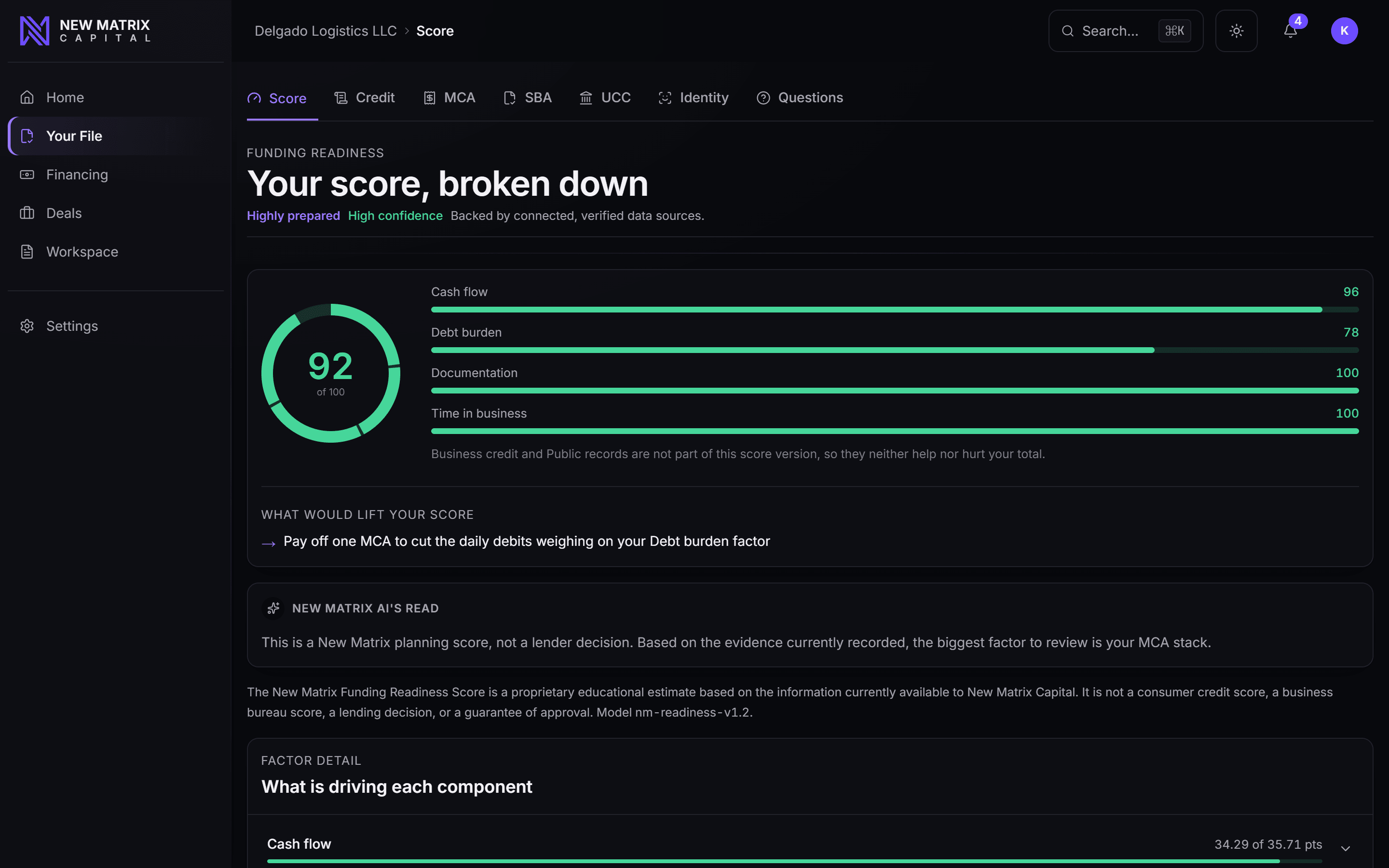
Evidence first, and every field says where it came from
Nothing is assumed. A number the account proves, a number you typed, and a number nobody has yet are three different things on your file, and they stay that way from the first read to the funder’s screen.
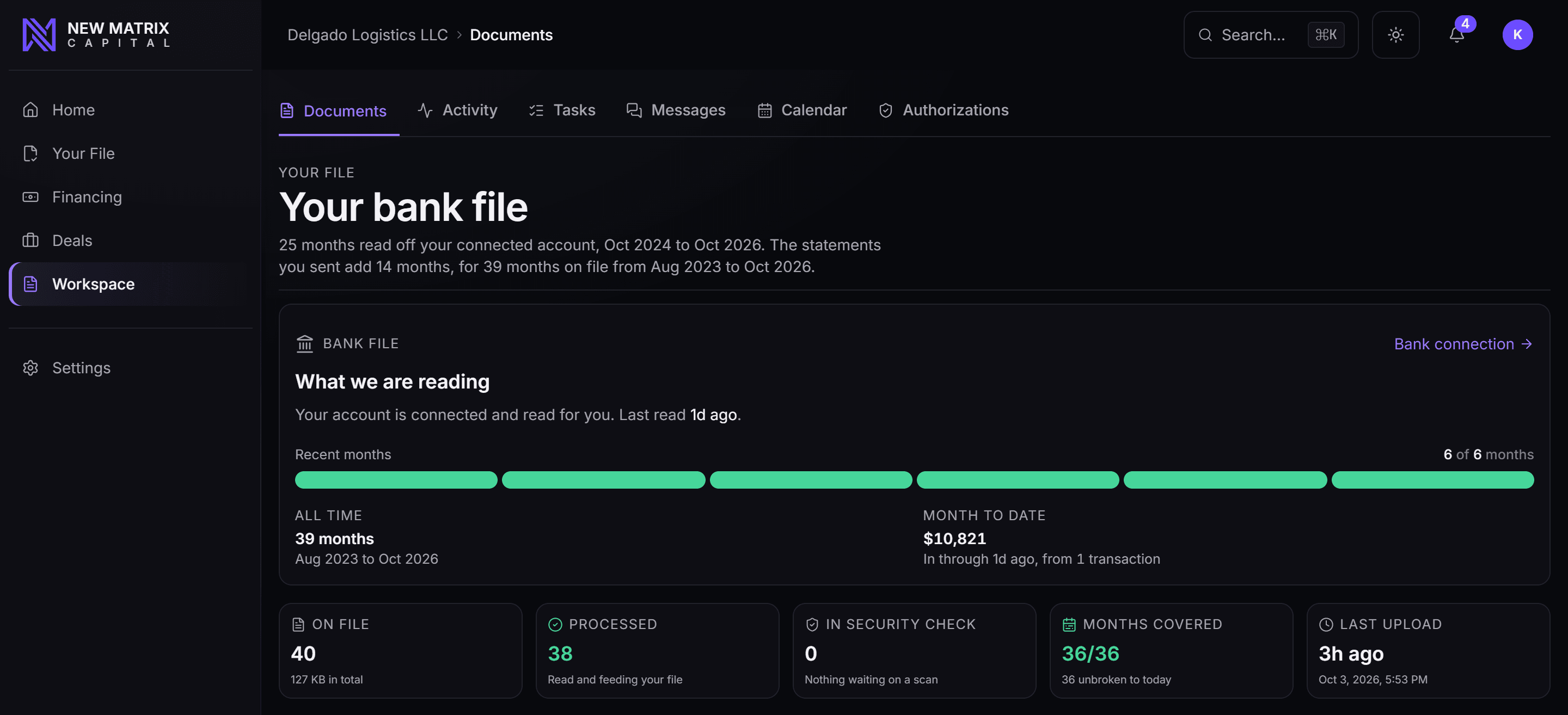
Where the evidence lands. Every field traces back to the document or the transaction it was read from.
The connected account
Pulled month by month from the bank itself. Deposits, withdrawals, transfers and true daily balances, not a summary you retype from memory.
Statements you already have
PDF, spreadsheet or a photo of the page. The register is read line by line, and a page that cannot be read comes back as an error you can see, never as a quiet zero month.
Business credit, once you authorize it
When a bureau pull is on the file, each score is dated and labeled with the bureau that returned it. We do not invent scores.
Filings and entity records
When we have run a lien search or pulled entity records, filings and identity checks land on your file, so a lien nobody mentioned does not surface for the first time at the funding call.
One connection, six answers you would otherwise pay for
None of this is a promise about what the platform could do. Each one is a tool that runs against your file the moment there is enough of it to run on.
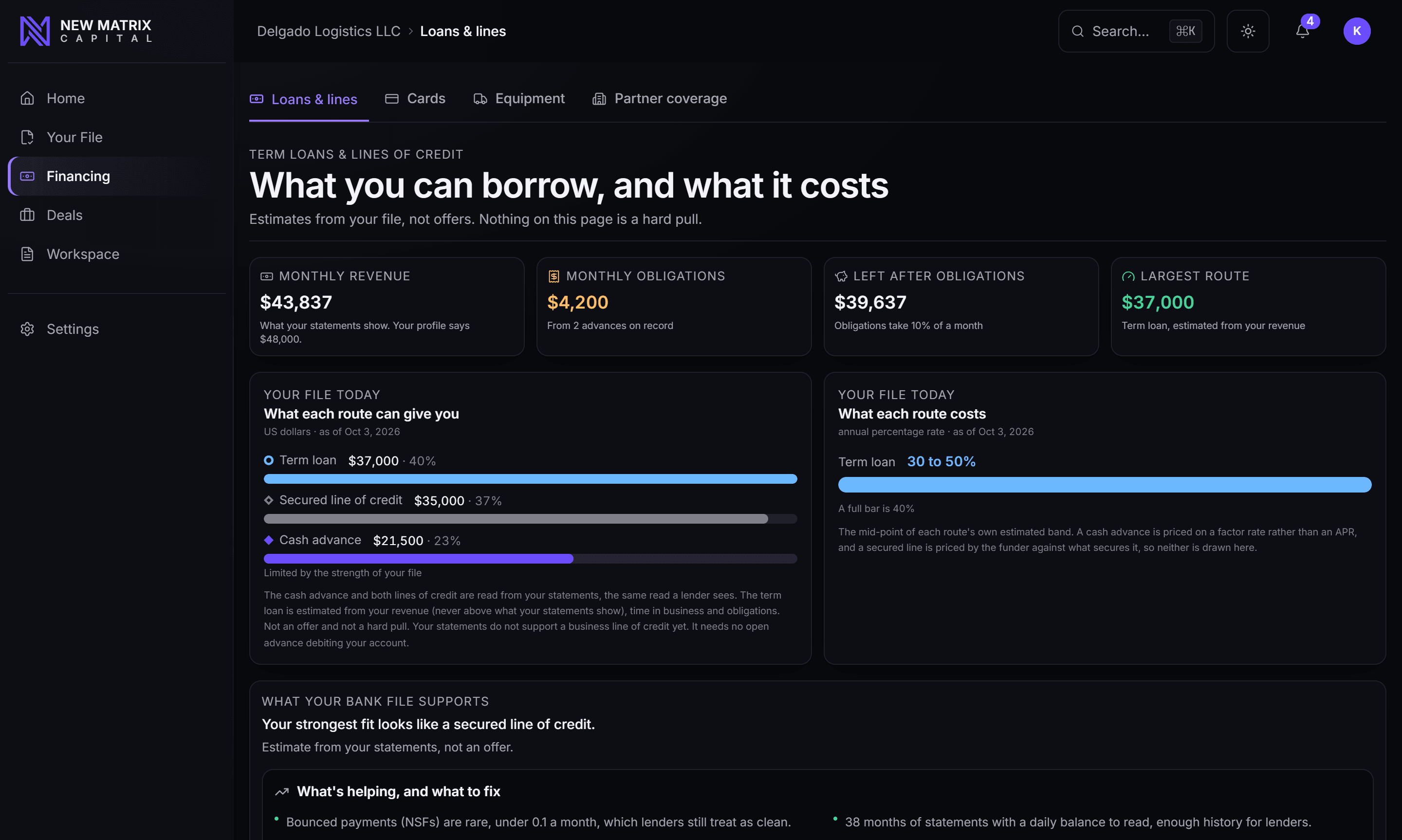
The cashflow picture
Monthly deposits and deposit count, negative days, and what the operating balance really looks like between debits.
Positions already on the account
Every advance debiting the account, found and counted with its cadence and daily amount, including the ones nobody wrote down.
Thirteen weeks of cash
Projected forward off your own account, so you know whether a daily payment fits before you agree to one.
The Matrix Score, with the reasons under it
One score you can open: what is strong, what is thin, and the single item that would move it most.
The missing document, named
Not a generic checklist. The one file holding the submission up, and what the funder wants it for.
The file against every box
Product, state, time in business, revenue, position count, measured against each funder’s published criteria. A match is not an approval, and it never claims to be.
In this business the confident answer is the dangerous one
Every limit below is enforced in the code path, not written into a policy nobody reads. They are the reason a funder can act on what arrives with your file.
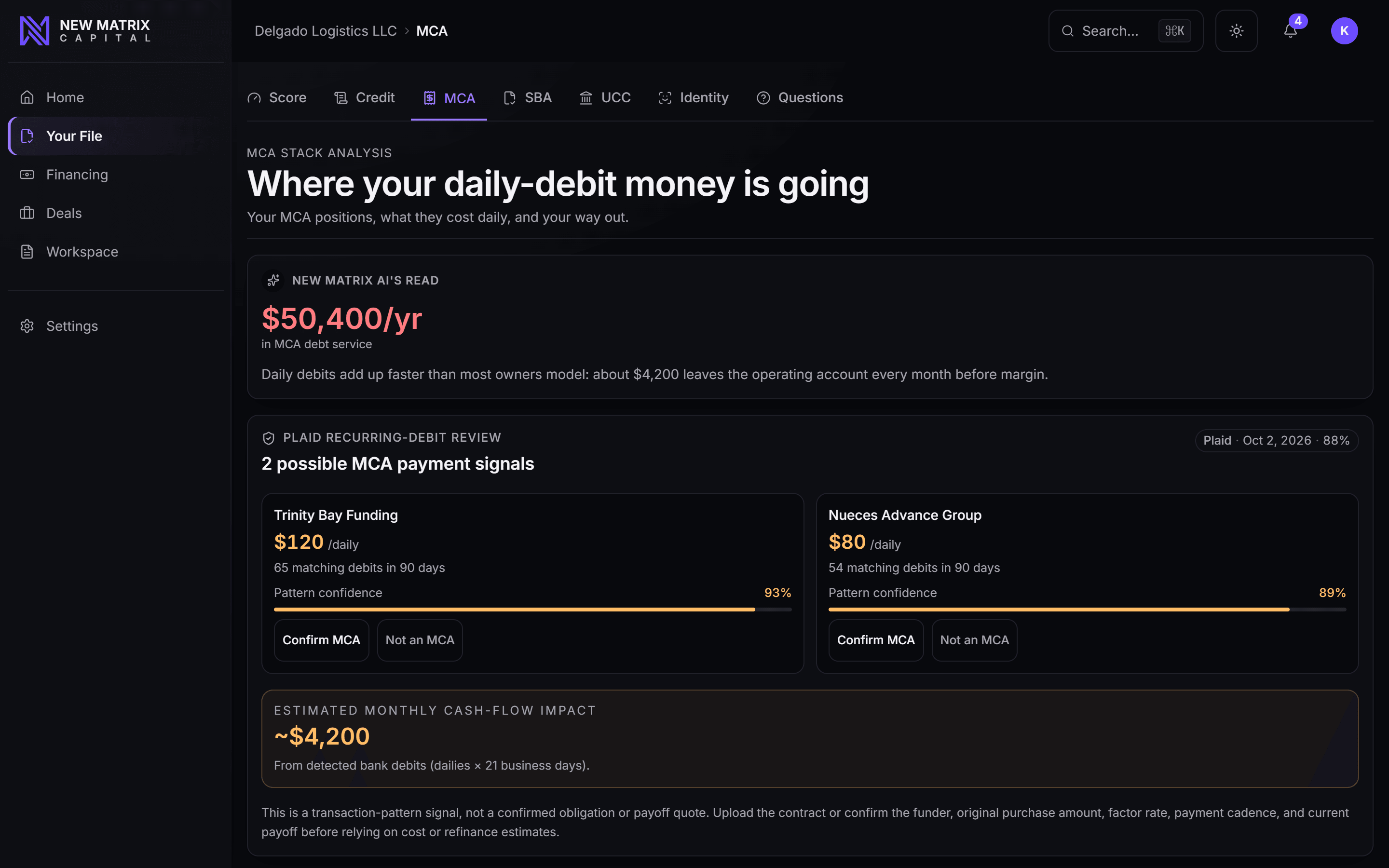
A read that says how sure it is. A position it only half-recognises says so, rather than being counted as a fact.
It will not invent a number
A figure the evidence does not support comes back as not analyzed yet. Never a zero standing in for an unknown, never an estimate dressed as a fact.
Evidence, your input, and gaps stay separate
Anything read off the connected account, anything you typed, and anything nobody has yet are three different states on your file, and they are labeled that way everywhere they appear.
Industry answers cite their source
Questions about rules, products and norms are answered from a written knowledge base with the source named. When the data cannot answer, it says so instead of filling the gap.
Identifiers are stripped before the model sees them
Account numbers, tax IDs and personal identifiers are redacted out of every request, and input is sanitized before it reaches the model at all.
Its own output is audited
Standing audits sweep its stored answers for figures that contradict the file, lenders named without a record behind them and leaked identifiers. While it is answering, the nightly run also sends it a rotating set of known jailbreak and cross-account prompts. Findings land in a review queue, not a log nobody opens.
A person sets the rules, and can stop it
Tone, blocked topics, forbidden phrasing and fixed answers are authored by an administrator, drafted and published as separate steps, and can be changed or switched off at any time.
The same read arrives with the file
A funder does not want a summary of a merchant, they want the paper with the finding pointed at. The notes ride on the statement itself, and the file has already been measured against the box before it reaches the queue.
Notes anchored to the line they are about
An observation sits under the exact transaction, or the exact month, it refers to. Anything that cannot be tied to a row or a period is not drawn at all, because an unanchored note on a bank statement is a claim about paper the paper does not make.
Saved as one stamped PDF
The parsed register with the notes on it, then, once the merchant’s identity is released to you, the bank’s own document as supplied, with the provenance stamp on every page. There is no code path that returns an unstamped copy.
Measured against your box before it lands
Your published criteria run first, and your own custom rules layer on top: knockouts, weighting, and stipulations suggested automatically on a file that passes, one click to request.
Where your offer sits, without naming anyone
A band tells you whether your terms are stronger, average or weaker than the rest of the field on that file. Never a competitor’s rate, amount or identity, and never a count of them.
Connect the bank and read your own file
Nothing is charged to join, to build the file, to connect an account, to be scored, or to compare what comes back.